Report on the Committee on Support of Faculty Scholarship
Jim Swartz, July, 2000
This
year this new committee (CSFS) took in a number of tasks previously done by
other committees and also instituted a substantial number of new programs. The goal of the reorganization of this
committee was to provide appropriate oversight by a single committee of a broad
range of opportunities for support and to develop consistent guidelines and
criteria for granting support for the scholarly work of faculty. As a result of a successful first year, the
committee has provided substantial additional support for scholarly work.
CSFS
continued the work of the previous Grant Board by reviewing and making
recommendations on Harris Leave proposals and on grants to support faculty
scholarship. CSFS took over the review of sabbatical leave and research leave
proposals from a committee of division chairs.
New programs initiated by CSFS included developing the study grant
program and a system for allocation of new funds to support faculty travel
beyond the typical single trip.
Leaves for Scholarly Work
CSFS
recommended 16 faculty sabbatical leaves, 7 for a full year and 9 for a single
semester. In reviewing proposals the
committee recognized that there were no guidelines for sabbatical proposals,
and they decided to develop such guidelines.
They are available at http://www.grinnell.edu/dean/Forms/Sabbatical-gdln.html.
CSFS also reviewed 7 Harris proposals and sent its recommendations to the Personnel Committee for final recommendation. Ultimately two faculty members received Harris leaves: Jenny Anger, for her proposal “Redressing Ornament: Modernism, Postmodernism, and Paul Klee”, and Jonathan (Jackie) Brown, for his proposal “Sexual Selection and the Radiation of Native Hawaiian Fruit Flies”. Jackie Brown has delayed his leave until 2001-02 to accommodate curricular needs in the Biology Department.
CSFS
reviewed and recommended a research leave to one junior faculty member.
Finally,
CSFS developed guidelines for an experimental leave program for Associate
Professors and Professors, using support from the Fund for Excellence. That Study Leave program has as its goal to
allow faculty to improve their scholarly productivity. It will be reviewed after several years to
see if it is having this effect. Four
faculty members were awarded Study Leaves:
Victoria Brown, for completion of a biographical book on the early life
of Jane Addams, The Education of Jane Addams; Susan Ireland, “Immigrant
Natives in Contemporary France”; Dan Kaiser, “Family Life in Early Modern
Russia”; and Alan Schrift, for completion of an anthology of French philosophy
that chronicles developments in French thought through the twentieth century. The
guidelines for Study Leaves are located at http://www.grinnell.edu/dean/Forms/Stdy-Lv-Gdlns.html.
Grants to Support Scholarly Projects
The
Committee awarded 35 grants to 31 faculty members during the academic year and
44 grants to 44 faculty members for summer work. Funding for these grants included $117,279.75 from the base
budget plus $10,097.00 from the Shepard foreign travel fund and $117,791.00
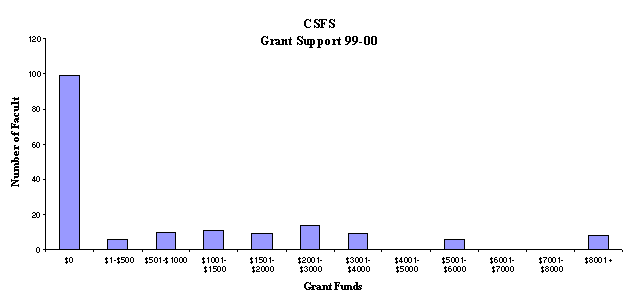
from Noyce science funds. A graph of
the total amount of awards provided to faculty follows below. The committee also made recommendations on
grants for summer support for MAP projects.
It recommended funding for 20 MAP projects for the summer of 2000.
In
making funding recommendations, the committee looked at the proposal, stage of
career and scholarly productivity of faculty members. It generally was pleased with the quality in these areas.
Travel Support
CSFS
reviewed the guidelines for travel support for ‘first’ trips to professional
meetings and established guidelines for applications and funding of proposals
for additional professional meetings.
Those can be found at http://www.grinnell.edu/dean/Forms/fac-trav-guides.html. The
committee established a maximum of $2000 for ‘first’ meetings, as they wanted
to maximize the funds that were left to support additional meetings. CSFS also
decided that, in making awards for second meetings, they favored providing
funding to more faculty at a somewhat lower level of support than funding to
fewer faculty at full support. Thus
most faculty receiving funding for additional meetings had some out-of-pocket
expenses.
Some
faculty travel support was allocated to the Instructional Support Committee to
award based upon needs to support curricular or pedagogical development and
projects.
The
following travel awards were made: 99 faculty for a total of $101,185.99 for
‘first’ trips, and 57 faculty for a total of $37,033.93 additional trips
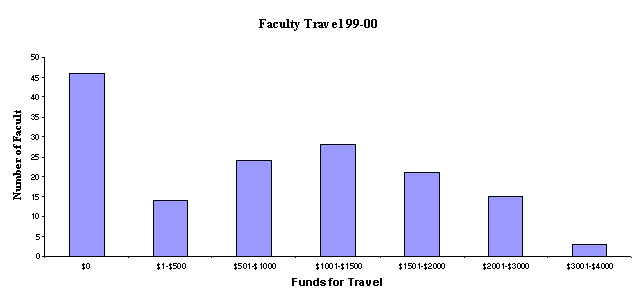
amounting to $138,219.92. A graph of
the amount of funding of faculty for faculty travel follows below.